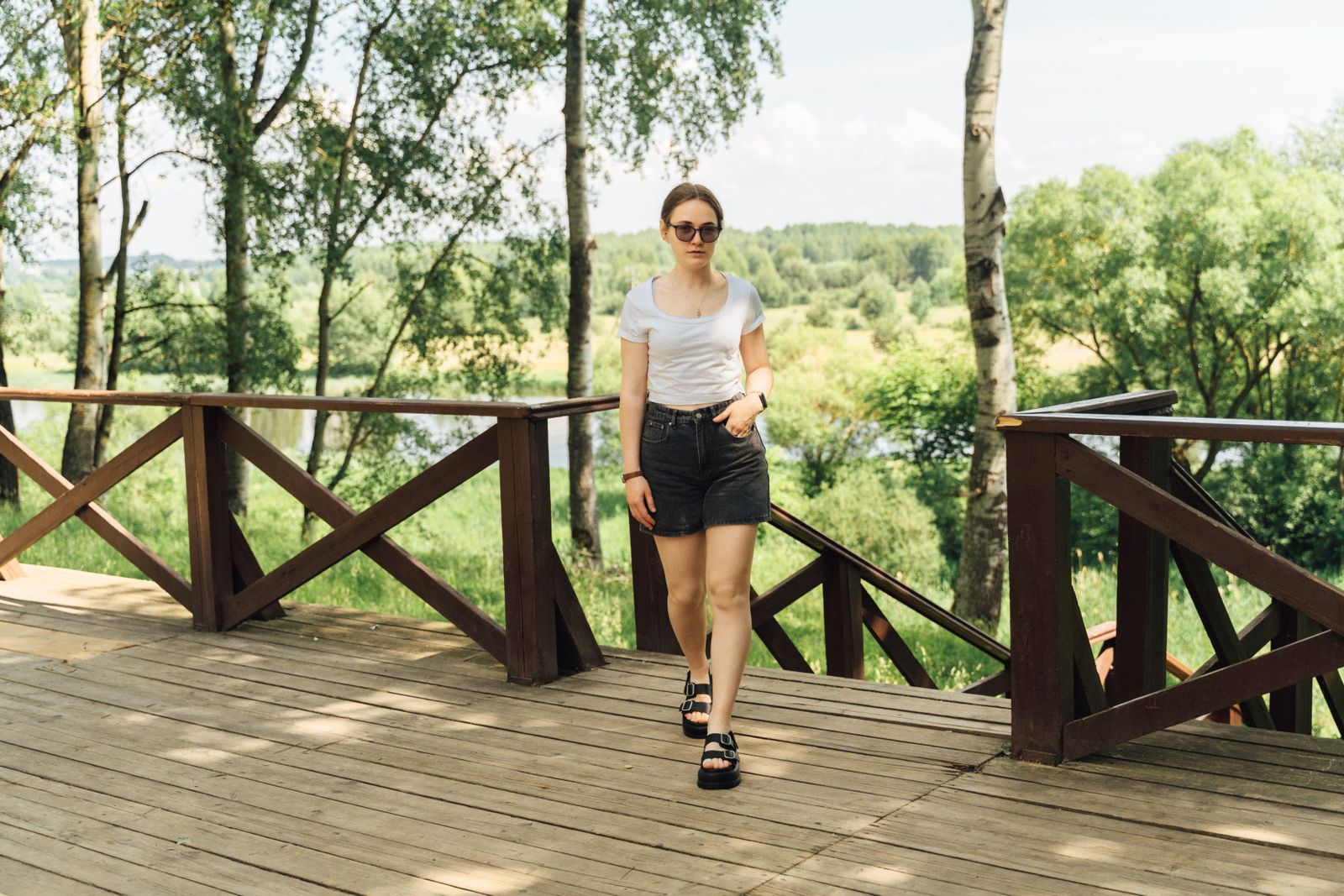
Pull-On Twill Shorts vs. Linen Shorts: Which Summer Bottoms Hold Their Shape Best?
Stretch twill holds its shape better than linen through a full day of wear. Twill is a tight diagonal weave with elastic blended in, so it resists wrinkling and springs back after sitting, while linen is a loose plain weave with almost no elasticity and creases within minutes of putting it on. Linen wins decisively on breathability and on a specific relaxed aesthetic; twill wins on structure, wrinkle resistance, and looking the same at 6 p.m. as it did at 9 a.m.
The right answer depends on which of those matters more for how the shorts will actually be worn.
What is the core difference between the two fabrics?
Linen is made from flax fibers. Those fibers are strong, hollow, and highly absorbent, which is why linen feels cool and dries fast. They are also stiff and have very little natural elasticity, so when the fiber is bent it stays bent. That is a wrinkle.
Twill refers to a weave structure rather than a fiber. The threads pass over two or more and under one or more, producing the visible diagonal ridge on the surface of chinos and denim. That structure is denser and more stable than a plain weave, which is why twill drapes with more body and resists creasing.
When elastane is blended into a twill and woven so the fabric stretches in all four directions, the fabric gains something linen fundamentally does not have: recovery. It can be deformed by sitting, walking, or bending, and it returns to its original shape on its own.
| Property | Stretch twill | Linen | | --- | --- | --- | | Weave | Dense diagonal twill | Open plain weave | | Wrinkle resistance | High | Low | | Shape recovery after sitting | Returns on its own | Holds the crease | | Breathability | Good | Excellent | | Stretch | 4-way in a stretch blend | Minimal to none | | Structure and leg line | Holds a clean line | Soft and loose | | Opacity | Generally opaque | Can be sheer in light shades | | Feel when new | Soft, becomes softer | Crisp, softens over years | | Best in | Travel, long days, mixed plans | Still heat, relaxed settings |
Which holds its shape best through a full day?

Photo by Connor Scott McManus on Pexels
Stretch twill, and the margin is not small.
The test that matters is a two-hour car ride followed by walking into somewhere. Linen shorts come out of that with deep horizontal creases across the front of the thigh and across the seat, and those creases stay until the garment is steamed. Stretch twill comes out with soft fold lines that relax within a few minutes of standing and walking.
The mechanism is the elastic component. A woven fabric with elastane distributed through it stores the deformation energy of being folded and releases it, pulling the fibers back toward their original position. Flax has no equivalent mechanism, so the fold is permanent until heat and moisture reset the fiber.
This is also why a pull-on waistband works better in stretch twill. A no-button, no-zipper design relies on the fabric to give at the waist when you sit and recover when you stand. Linen would either need to be cut loose enough to be shapeless or would feel restrictive.
Which is cooler in genuine heat?
Linen, in still air. Flax fibers are hollow and highly absorbent, and the open weave lets air move freely. In hot, dry, still conditions — a shaded patio, a Mediterranean afternoon — linen genuinely feels cooler against the skin than almost any woven alternative.
Two caveats keep this from being a clean win:
- In humidity, the advantage narrows. Linen's cooling comes largely from moisture evaporating off the fiber. When the air is already saturated, that evaporation slows and the fabric can feel damp and clingy.
- A cotton-family twill is not hot. Cotton breathes well on its own. A stretch twill short in a warm-weather weight is comfortable in summer heat, particularly in a shorter inseam. The difference against linen is noticeable but modest.
Which needs less maintenance?
Stretch twill, clearly.
Linen upkeep:
- Wrinkles from wearing, sitting, packing, and washing
- Needs steaming or ironing before most occasions where appearance matters
- Light colors can be semi-sheer
- Softens beautifully over years but starts stiff
- Wash inside out in cold water on a gentle cycle
- No fabric softener, no bleach, low heat or air drying
- Rarely needs pressing if smoothed while damp
- Garment-dyed shades will fade gradually and can transfer color onto lighter materials early on
Which travels better?
Stretch twill, for four reasons:
Linen is the better choice for a trip that is mostly stationary and mostly hot — a beach week, a lake house — where the relaxed, crumpled look is part of the point rather than a problem. The case for twill as a travel fabric goes further into packing decisions.
Which looks more polished?

Photo by ROMAN ODINTSOV on Pexels
This depends on the look being aimed at, but for anything with an implied dress code, twill is the more reliable choice.
Twill's density means a clean hem, a defined leg opening, and a leg line that stays where it was cut. Paired with a high waist and a tucked top, it reads close to a tailored short. A garment-dyed finish adds depth to the color without making it look casual.
Linen has a different kind of elegance — soft, coastal, deliberately undone. It is genuinely beautiful in a linen-appropriate context and looks careless in a context that expects crispness. Because linen creases from the moment it is worn, its polished window is roughly the first ten minutes of the day.
For an event where you will be photographed at an unpredictable moment, twill is the safer bet.
How to choose between them
Pick stretch twill if:
- The shorts will be worn for long days with travel, sitting, and walking mixed in
- Wrinkle resistance matters more than maximum airflow
- A defined waist and a smooth front line are priorities
- Low-maintenance is a real requirement
- One pair needs to cover casual mornings and put-together evenings
- The setting is consistently hot, dry, and low-activity
- The relaxed, softly rumpled aesthetic is the goal
- Maximum breathability outweighs everything else
- Steaming before wearing is not an inconvenience
FAQ
Are linen-cotton blends a good compromise? They are a real improvement on pure linen for wrinkle resistance, and they keep much of the breathability. What they usually do not have is stretch, so a blended linen short still cannot deliver the recovery or the comfortable pull-on waistband that a 4-way stretch twill can. Think of blends as better linen rather than as a substitute for stretch twill.
Does stretch twill get hot in high summer? It is warmer than linen but comfortable in ordinary summer conditions, particularly in a shorter inseam where less fabric covers the leg. Cotton-family fibers breathe and move moisture reasonably well. The difference is noticeable in direct midday sun and negligible indoors or in shade.
Which fabric lasts longer? Flax fiber is exceptionally durable and linen can last decades, but linen garments often fail at seams and hems from repeated pressing rather than from fiber wear. Stretch twill is durable in the weave, and its lifespan is usually governed by the elastic component, which is why cold washing and low-heat drying matter so much for it.
Do garment-dyed twill shorts fade more than linen? Garment-dyed fabric is designed to soften in color over time, so yes, the shade will move. Washing inside out in cold water slows it considerably. Linen also fades, particularly in sun, but usually more slowly and less visibly since linen is often sold in lighter shades to begin with.
A practical next step
Decide based on the next two weeks rather than in the abstract. Write down the four or five occasions the shorts will actually be worn for. If most of them involve a car, a train, a long day, or a room where you want to look put-together, choose stretch twill and take the 6-inch inseam. If most of them are stationary and hot, linen earns its place. If it is genuinely split, the comparison against denim is a useful third data point, since denim is the fabric most people are replacing when they buy either one.
Cover photo by Siarhei Nester on Pexels.