
Pull-On Tummy Shaping Shorts vs. Traditional Button Shorts: Which Silhouette is Right for You?
The closure on a pair of shorts changes their silhouette, not just their convenience. A button-and-zipper front builds a fixed, structured shape that your body fits into, with a visible fly seam and belt loops interrupting the front. A pull-on waistband with hidden shaping builds a continuous, uninterrupted line that follows your body and stays smooth under a tucked top. Which silhouette is right depends on whether you want structure or continuity — and on how often you sit down.
The two silhouettes, described precisely
The button short silhouette. A rigid waistband holds a circle at one measurement. Below it, a fly seam runs vertically for a few inches, flanked by a button, and belt loops sit at intervals around the top edge. The result is architectural: the garment holds its own shape whether or not you are in it. Visually, the front has three interruptions — the hardware, the fly stitching, and the loops — which read as detail.
The pull-on shaping silhouette. A wide elasticized waistband distributes hold evenly around the full circumference, with no fastener to interrupt it. The front is a continuous plane. On the Women's Comfy Stretch Twill Shorts, hidden tummy shaping sits behind that plane and keeps it flat, and the outer surface carries patch pockets rather than a fly. Visually, the front reads as one clean piece, with the waistband as the only horizontal line.
Neither is inherently dressier. Structure and continuity are two different design languages, and the fabric usually decides formality more than the closure does.
Side by side
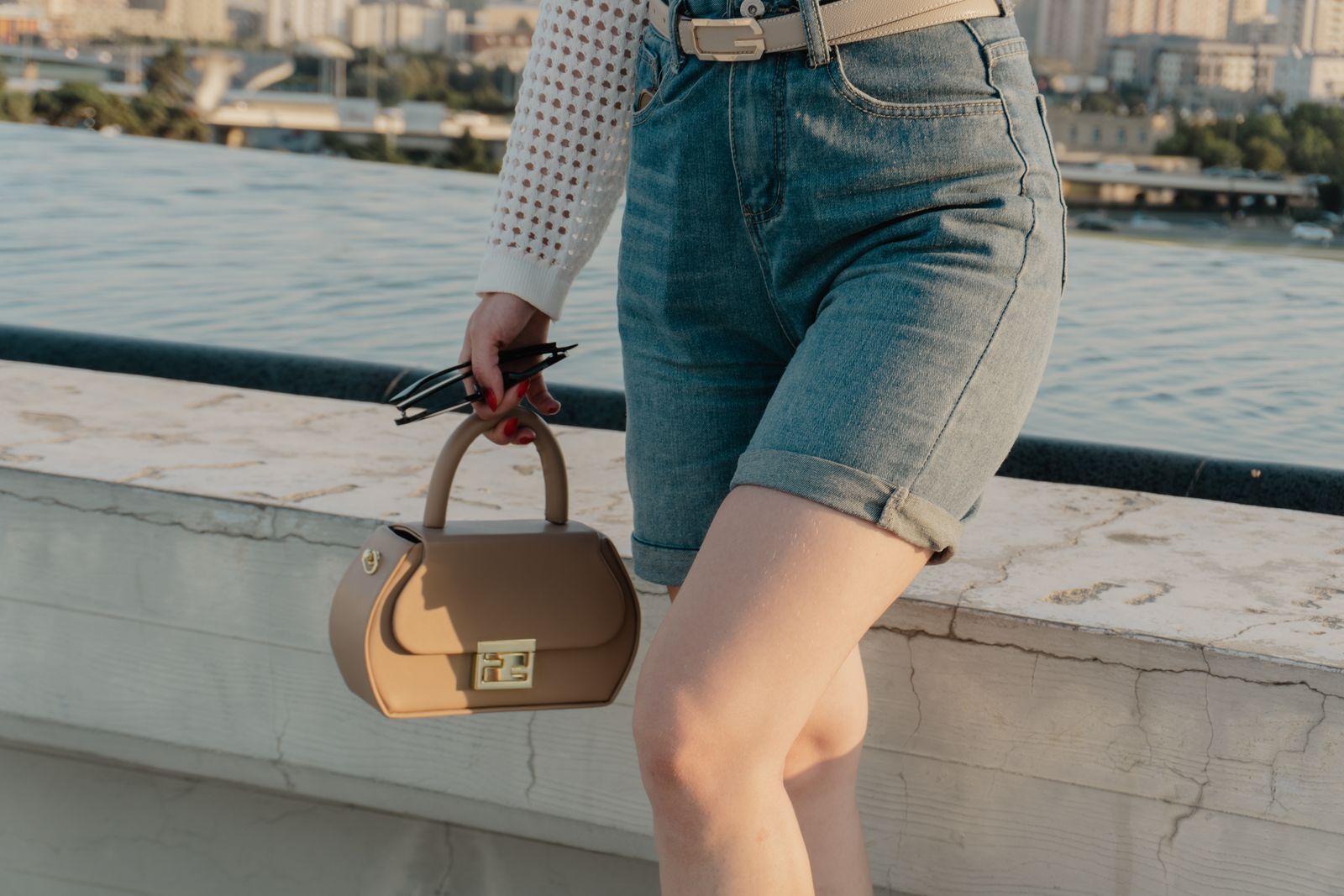
Photo by Zulfugar Karimov on Pexels
| Aspect | Traditional button shorts | Pull-on tummy shaping shorts | |---|---|---| | Front appearance | Fly seam, button, belt loops | Continuous, no hardware | | Waist hold | Concentrated at one closure point | Distributed around the full circumference | | Response to sitting | Fixed measurement; pressure increases | Expands and recovers | | Under a fitted top | Hardware can create visible ridges | Flat, no ridges to show | | Belt compatibility | Designed for one | Not needed; no loops | | Size tolerance | Narrow; half a size is noticeable | Wider; the band adjusts | | Getting dressed | Zip and fasten | Step in and pull up | | Waistband position through the day | Can slide if the hip is snug | Holds position |
Where the silhouette difference shows in real outfits
Tucked tops. This is the clearest case. A tucked top over a button front has to sit over the hardware, and the button plus the fly seam plus the tucked fabric stack into a small area. A continuous waistband gives the tuck a flat surface to sit against. If most of your tops are tucked, the pull-on silhouette is the easier one to dress.
Fitted and lightweight tops worn untucked. Thin fabric shows what is underneath it. Belt loops in particular create small vertical ridges under a drapey top. A flat waistband does not.
High-waisted styling. Both silhouettes exist in high-waisted cuts, but they behave differently at the top edge. A rigid high waistband holds a fixed circle above the natural waist, which is comfortable if your measurement matches it exactly and uncomfortable if it does not. An elasticized high waistband adjusts to the measurement it finds, which is why high-rise pull-on styles have a wider fit tolerance than high-rise button styles.
Layered outfits. Where a layer ends matters more than the closure. A blazer or overshirt that finishes at the hip covers the waistband on either style, at which point the silhouette difference is invisible and the fabric does all the talking. Everyday casual pairings for high-waisted shorts covers where those layers land.
When a button short is genuinely the better choice
It would be dishonest to say pull-on wins in every case. Three situations favor the traditional construction.
- You want to wear a belt as an accessory. Belt loops are functional hardware, and no pull-on style has them. If a belt is part of how you build outfits, that is a real constraint.
- You want a rigid, architectural line. Some looks depend on fabric standing away from the leg and a waistband holding a hard circle. Heavy rigid wovens with a fixed closure do that; stretch fabrics deliberately do not.
- Your workplace expects visible tailoring detail. In a few environments, a fly front and belt loops read as "trousers" in a way a pull-on style does not. This is more about convention than about how the garment looks.
How fabric changes both silhouettes

Photo by Margo Evardson on Pexels
Closure and fabric interact, which is why comparing a rigid button short to a stretch pull-on short is really comparing two systems rather than two fasteners.
A woven twill with 4-way stretch gives along both the length and the width. In a pull-on construction, that combination is coherent: the band adjusts, the fabric adjusts, and the whole garment moves as one. In a button construction, stretch fabric partly fights the closure — the cloth wants to give, the waistband will not, and the tension lands at the button.
Two more fabric factors affect the look:
- Drape. Softer twill follows the leg rather than standing away from it, which produces a rounder, softer silhouette on either closure.
- Surface. Garment dyeing, where the finished shorts are dyed rather than the yardage, produces a slightly variegated, worn-in surface. That reads as relaxed rather than crisp, and it pairs naturally with a continuous front. It also means the color fades gradually with washing and can transfer onto lighter materials, so washing inside out is worth doing from the start.
Choosing between them in four questions
Two yes answers toward the pull-on side is enough to make it your default. On the waistband question specifically, what replaces a stiff waistband and why it works covers the mechanics.
Frequently asked questions
Do pull-on shorts look less tailored from a distance?
At normal viewing distance, what registers is the fabric, the hem, the fit through the hip, and the flatness of the front. Hardware is a close-up detail. A well-fitting pull-on short in a solid woven twill reads as tailored.
Can I still wear a belt with a pull-on style?
Not functionally, since there are no loops and the waistband does not need one. A belt worn loosely over the waistband as pure decoration is possible, but it tends to disrupt the continuous line that is the point of the silhouette.
Which construction stays up better on a long walk?
The pull-on, in most cases, because its hold is distributed. A button short holds at one point, and when the hip is snug that point gets pulled downward with every stride.
Is hidden shaping the same as wearing shapewear underneath?
No. Shapewear is a separate compression layer. Hidden shaping is a panel built into the front of the garment that keeps the outer fabric smooth and the waistband stable, with nothing extra to put on.
A practical next step
Look at the five outfits you wear most this month and count how many involve a tucked top or a belt. If tucking wins, the pull-on silhouette is the one to buy next, in the inseam that matches where you like your hem — 6 inches for a mid-thigh hem, 4 inches for a shorter one. If belts win, keep the button pair for those outfits and add a pull-on pair for everything else.
Cover photo by Yaroslav Shuraev on Pexels.