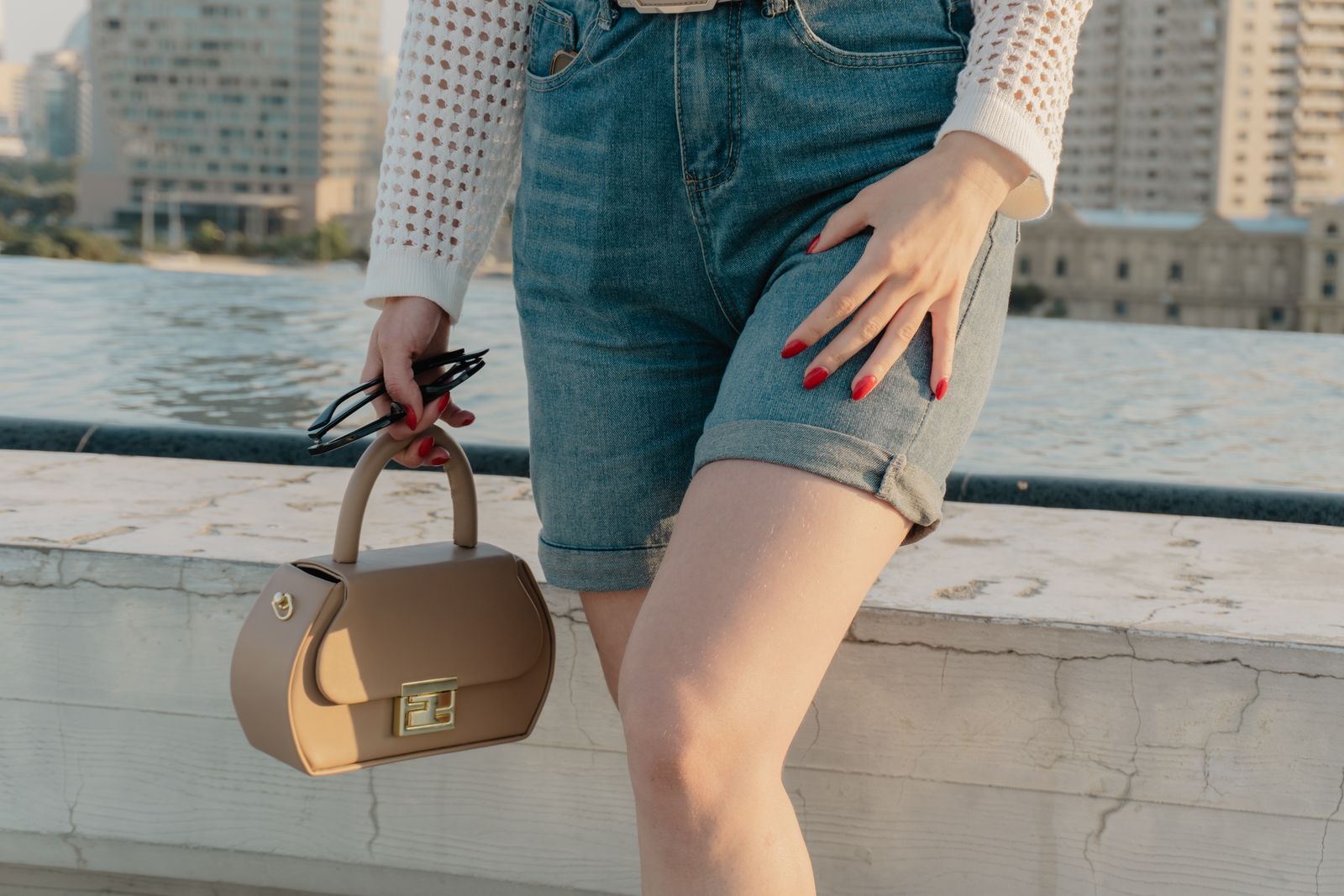
How to Ditch Button Dig: Why Women Are Swapping Denim for Stretch Twill Shorts
Button dig is what happens when a rigid waistband and a single fastening point have to absorb every change in your posture. Sitting increases the circumference of the waist by roughly an inch to an inch and a half for most people, and a non-stretch denim waistband has nowhere to put that extra inch except into your skin. Pull-on stretch twill shorts solve it by replacing the fixed closure with an elasticized waistband that expands and returns, which is the single biggest reason people move away from denim cutoffs for everyday wear.
Why does the button dig in the first place?
The problem is geometry, not sizing. A woven denim waistband is a closed band of stiff fabric interrupted at one point by a button and a short zipper. All of the tension created when your body position changes travels to that interruption, because it is the only part of the band that can move — and it cannot actually move, because the button holds it shut.
Three ordinary situations concentrate that tension:
- Sitting. The torso compresses forward and the waist circumference grows. The waistband cannot grow with it.
- Driving. The seat belt and the seated position both push the waistband against the abdomen for a sustained period.
- Eating a normal meal. Digestion changes waist measurement over the course of an hour, and a fixed band measured while standing is now a size behind.
What makes stretch twill behave differently?

Photo by Đậu Photograph on Pexels
Two things: the weave and the fiber content. Twill is a diagonal weave, which is naturally more pliable and drapes better than the tighter, heavier weaves typical of rigid denim. When that twill is engineered with 4-way stretch, it gives along both the length and the width of the fabric, so a bend at the hip does not have to be paid for somewhere else in the garment.
The Women's Comfy Stretch Twill Shorts use a buttery-soft 4-way stretch twill with no button and no zipper. The pull-on construction means the waistband is a continuous elasticized band rather than a band with a fastener in it, so there is no single point where tension collects. Add a high-waisted cut and hidden tummy shaping worked into the front, and the hold is spread across a wide surface instead of a narrow line.
A useful way to think about it: rigid denim asks your body to hold a shape for the garment. Stretch twill asks the garment to follow your body through the day. Neither approach is more correct as clothing — but only one of them stops leaving a mark at the waist by 4 p.m.
Denim shorts versus pull-on stretch twill shorts
| Factor | Rigid denim shorts | Pull-on stretch twill shorts | |---|---|---| | Closure | Button and zipper at center front | No button, no zipper; step-in waistband | | Response to sitting | Waistband holds its measurement, pressure increases | Waistband expands and recovers | | Stretch direction | Little to none, or lengthwise only | 4-way, both length and width | | Front appearance | Hardware and fly seam visible | Clean front with patch pockets | | Fit tolerance | Narrow; a half size matters | Wider; the band adjusts | | Break-in period | Weeks of wear to soften | Soft from the first wear | | Color behavior | Indigo fades at stress points | Garment-dyed, fades evenly and gradually |
The case for twill over denim as a summer staple walks through the seasonal side of the same comparison.
How to shop for a genuine denim alternative
Not every pull-on short is an upgrade. Plenty of them solve the pressure problem by giving up structure entirely, which is how you end up with something that reads as sleepwear. Use this checklist to separate the two.
Does giving up the zipper mean giving up a tailored look?

Photo by Micah Eleazar on Pexels
No, and it is worth being precise about why. What makes a short read as tailored is the fabric's body, the cleanliness of the hem, the flatness of the front, and the fit through the hip — not the presence of hardware. A zipper is a mechanism, and mechanisms are not visible from six feet away.
Garment dyeing helps here in an unexpected way. Because the finished shorts are dyed rather than the yardage, the color has a slightly softened, worn-in depth that flat piece-dyed fabric does not. That is a look most people associate with well-made casual clothing rather than with athleisure. The tradeoff, which is worth knowing before you buy, is that the shade fades gradually with washing and can transfer onto lighter materials, so light upholstery and pale bags need a moment's thought early on.
For anyone wondering how far this style stretches toward the professional end, whether twill shorts work in a casual workplace covers where the line usually falls.
Frequently asked questions
Will an elasticized waistband look bulky under a fitted top?
A wide, flat, covered band generally reads smoother under a fitted top than a denim waistband does, because there is no button, no fly seam, and no belt loops creating ridges. Bulk comes from hardware and stacked seams more than from elastic.
Are pull-on shorts only for warm weather?
The inseam decides that more than the closure. A 6-inch inseam works comfortably into early fall with a sweater and boots, while a 4-inch reads squarely as warm-weather. The fabric itself is a mid-weight woven, not a summer-only novelty.
Do these stretch out over the course of a day?
Fabric engineered for 4-way stretch is chosen specifically for recovery, which means it returns after being stretched rather than staying loose. Where recovery does suffer is in high heat, so a cool wash and a low or no dryer setting matters more than anything you do while wearing them.
How do they compare to shorts that have both elastic and a zipper?
Hybrid styles put a partial elasticized panel at the sides and keep a fixed front. That helps with sizing tolerance, but the front is still rigid, so the sitting problem is only partly addressed. The full pull-on versus zippered breakdown goes through the middle ground in detail.
A practical next step
Run one test before you buy anything. Put on the shorts you currently own, sit down in a dining chair for two minutes, and note where the waistband presses. That spot is your requirement. Then look for a pull-on stretch twill pair sized to your standing waist measurement, in the inseam that hits the point on your leg you actually like, and repeat the same chair test when it arrives.
Cover photo by Zulfugar Karimov on Pexels.